Massal Stories

Beyond the Tin Roof

An illustrated story by Özkan Yazgan · Drama · Manga · 16+ · English

A struggling fifteen-year-old discovers that his dreams are real astral journeys, but learning where he can travel is easier than learning whom to trust—and whether he is the only one.

This is the first ten-episode arc of an ongoing story, not a complete series ending. Episodes 1–2 retain their established plot: Noah Vale's difficult home and school life comes first, followed by a nighttime journey and the recovery of his mother's missing locket, proving he traveled outside his body. Episodes 3–4 follow the consequences in daylight. His parents and Ms. Bell begin a practical school safety plan, Mason resists accountability, and Noah and Lena finally draw together by the harbor. Noah starts recording his experiences without assuming he understands their limits. Episodes 5–6 bring his first ethical problem: during an astral exploration of a disused tide-gauge chamber, he notices water entering an adjoining service passage. Unable to touch anything or repair the fault, he must tell his family and let authorized adults investigate. Their response confirms a maintenance problem, not a spectacular disaster, and does not erase the family's financial strain. Episodes 7–8 develop trust with Lena. She challenges his evasiveness without demanding his secrets; he chooses to tell her, and they arrange a consensual observation test using a still life in their classroom. His accurate drawing gives her a concrete reason to believe him, while establishing that private lives are not his to explore without permission. Episode 9 returns firmly to the bullying: another attempt at intimidation is witnessed and addressed through the school's ongoing process. Noah gains support and some breathing room, not an instant apology or permanent guarantee of safety. In Episode 10, an ordinary nighttime journey reveals a second white thread crossing the harbor toward an old bell tower. Noah chooses to return rather than follow it recklessly. The opening arc ends with stronger waking relationships, an unresolved supernatural question, and room for Episode 11 and beyond.

Characters

  • Noah Vale (Protagonist; a struggling schoolboy discovering astral travel): A fifteen-year-old newspaper delivery boy and student who notices how things work and how much things cost. He sketches boats in the margins of his schoolwork and enjoys repairing appliances with his father. He conceals his worries behind dry humor. His family matters deeply to him, but he also needs room to be a child with interests of his own.
  • Mira Vale (Noah's mother; night cleaner at the ferry terminal): A thirty-nine-year-old mother who works nights and keeps a small notebook of household expenses. She is affectionate without fuss and notices more of Noah's exhaustion than he realizes. Her oval brass locket belonged to her mother and has little monetary value but great personal importance.
  • Daniel Vale (Noah's father; former shipyard worker who repairs appliances at home): A forty-two-year-old former shipyard mechanic whose old right-wrist injury prevents heavy work. He repairs radios, lamps, and kettles at the kitchen table for modest income. He teaches Noah patiently and remains an active parent, not simply an emblem of the family's troubles.
  • June Vale (Noah's younger sister; his closest confidante at home): An eight-year-old who builds boats from packaging and asks Noah questions he cannot answer. She understands that money is tight but does not fully understand the adults' worries. Her imagination and occasional impatience give the family scenes ordinary warmth.
  • Mason Reed (School antagonist; a classmate whose repeated bullying escalates into physical intimidation): A sixteen-year-old in Noah's class who deliberately targets his poverty, repaired belongings, and reluctance to draw attention. What began as public mockery has become a pattern of obstructing his path, grabbing his possessions, and threatening consequences if he seeks help. In the classroom confrontation, Mason dumps Noah's satchel, tears a loose boat drawing, and shoves him against the edge of his desk. He then uses a low threat to discourage reporting. His behavior is calculated to make Noah feel unsafe even when he is absent. The story neither excuses his cruelty nor suggests that Noah must defeat him physically.
  • Lena Park (Noah's classmate, emerging friend, and first love interest): A fifteen-year-old who fills a pocket sketchbook with harbor buildings, passengers, and ordinary moments. She hopes to draw illustrated travel journals someday, starting with the town she knows. She has noticed Noah's boat sketches before finding the courage to ask about them. When Mason targets him, she offers practical support without speaking over him. Her interest in his designs becomes a tentative personal connection; she is not yet his girlfriend or aware of his astral travel.
  • Ms. Ada Bell (Noah's teacher and named trusted adult in the school safety plan): The teacher who recorded Noah and Lena's initial report. She becomes an on-page presence as the school follows up. She documents specific behavior, listens to Noah's concerns about retaliation, and coordinates practical support with his parents. She does not promise that one meeting will solve everything or require Noah to reconcile with Mason.

Episode 1: The Weight of Morning

Introduce Noah's family, work, interests, severe school bullying, and tentative connection with Lena before his first apparent dream-flight. The existing ten-frame story remains unchanged.
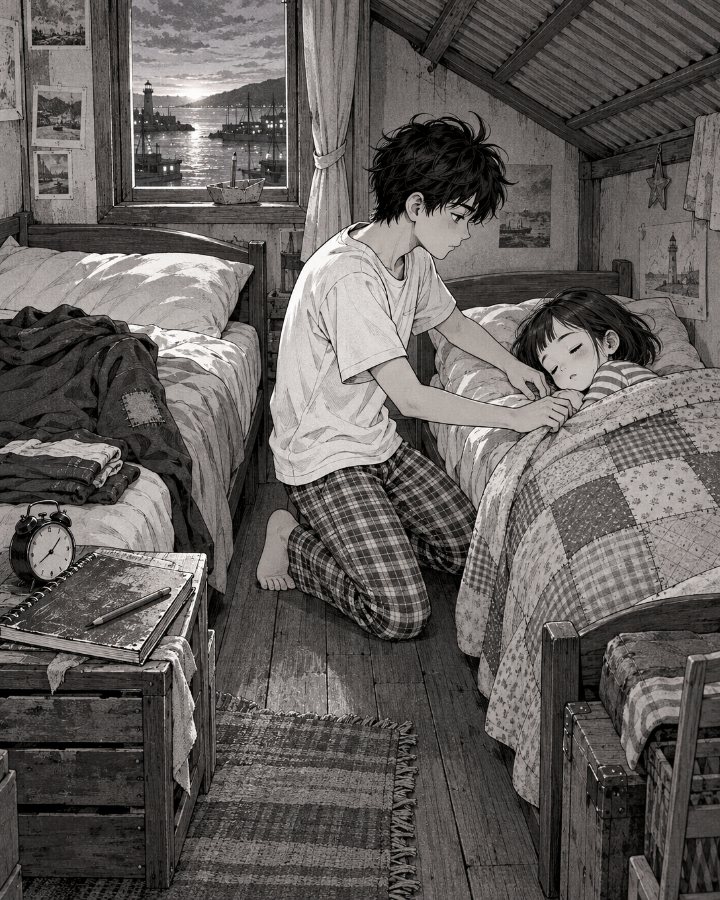
Noah has stopped the alarm almost before it sounded. Still in his sleepwear, he kneels beside June's bed and pulls her slipped quilt over her shoulder. His neatly folded daytime clothes wait on the bedside crate, the hoodie's repaired elbow uppermost. Nothing explains the family's circumstances; the careful routine speaks for itself.
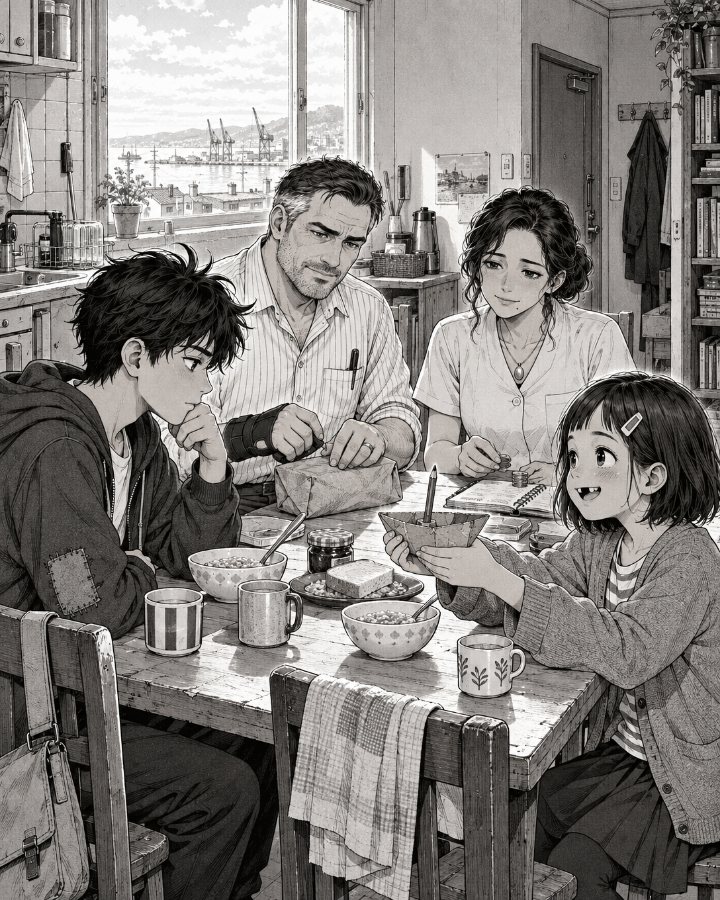
All four Vales share breakfast at the small table. Mira separates bus coins beside her expense notebook while Daniel wraps Noah's lunch, doing the firmer folds with his left hand. June insists that her cardboard boat deserves a proper engineering trial. Noah answers with mock professional seriousness.

June Vale: It's a proper boat. It needs a proper test.

Noah Vale: After breakfast. Dry docks only.
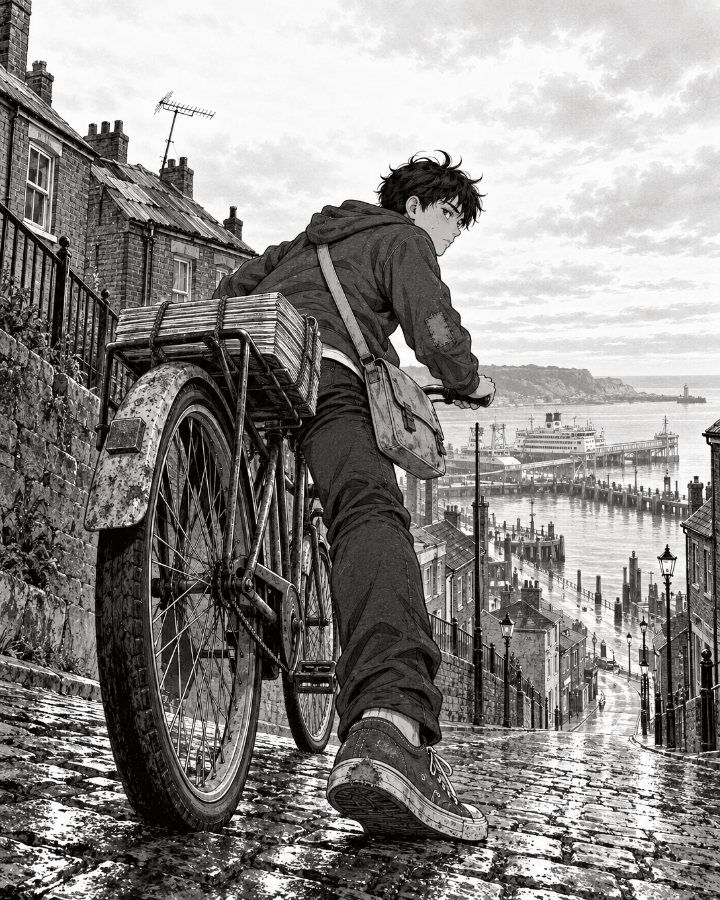
Noah pushes his loaded delivery bicycle up Hill Street. His repaired left sneaker presses into the wet incline, while the harbor lies far below. His thought supplies a little dry humor without diminishing the effort.

Noah Vale: The sea gets the easy part. Everything runs downhill.

The frame catches the immediate aftermath, not a repeated depiction of the violence. Mason has emptied Noah's satchel, deliberately torn a loose boat study, and shoved him hip-first into the desk edge. Noah braces against the desktop, breath caught. Mason still grips the satchel strap low beside Noah's ribs, keeping it taut so Noah cannot simply step away. His casual mockery drops into a private threat. Lena stands in the clear aisle and offers to get a teacher. Noah turns toward her and gives a small, frightened but deliberate nod. There is no graphic injury or retaliatory blow.

Mason Reed: Still can't afford a proper bag?

Mason Reed: Tell a teacher and tomorrow's worse.

Lena Park: I'll get a teacher. Do you want me to?
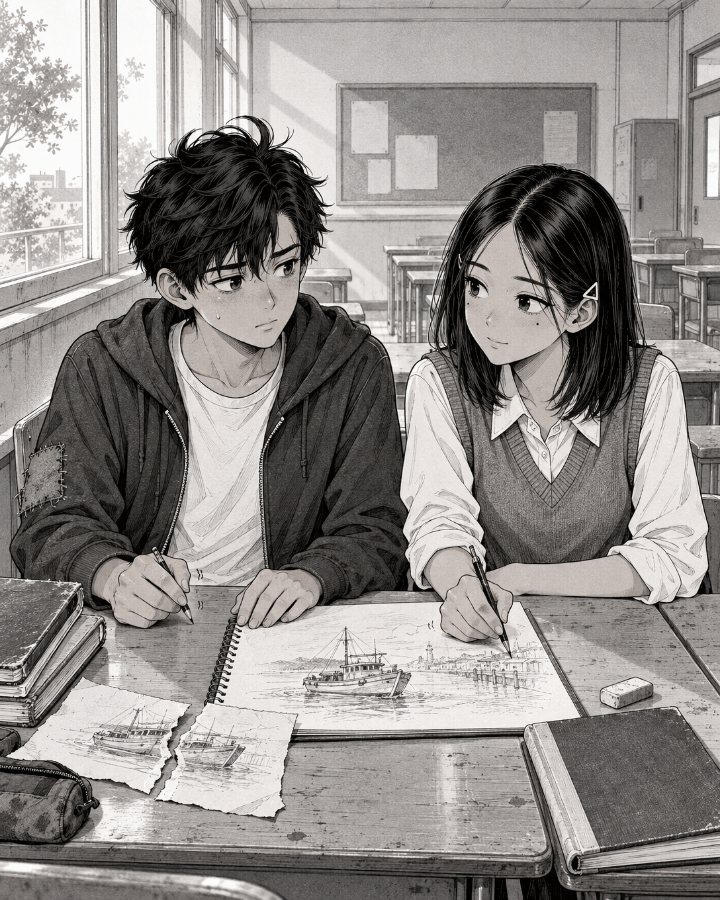
After lessons, their teacher has recorded the account, including the shove and threat, and kept Mason away for the remainder of the school day. This is a first protective step, not a resolution. Noah sits with his recovered books and the two torn pieces beside his intact sketchbook. His pencil hand trembles; Lena lets the silence last rather than urging him to draw. After his permission, she begins a light harbor outline around an intact boat sketch and tentatively suggests drawing by the water together. His small smile arrives without loosening all the tension in his shoulders.

Their teacher recorded the report and kept Mason away for the rest of the day.

Lena Park: Can I add the harbor? Maybe we could draw there together sometime?

Noah Vale: Yes. I'd like that.
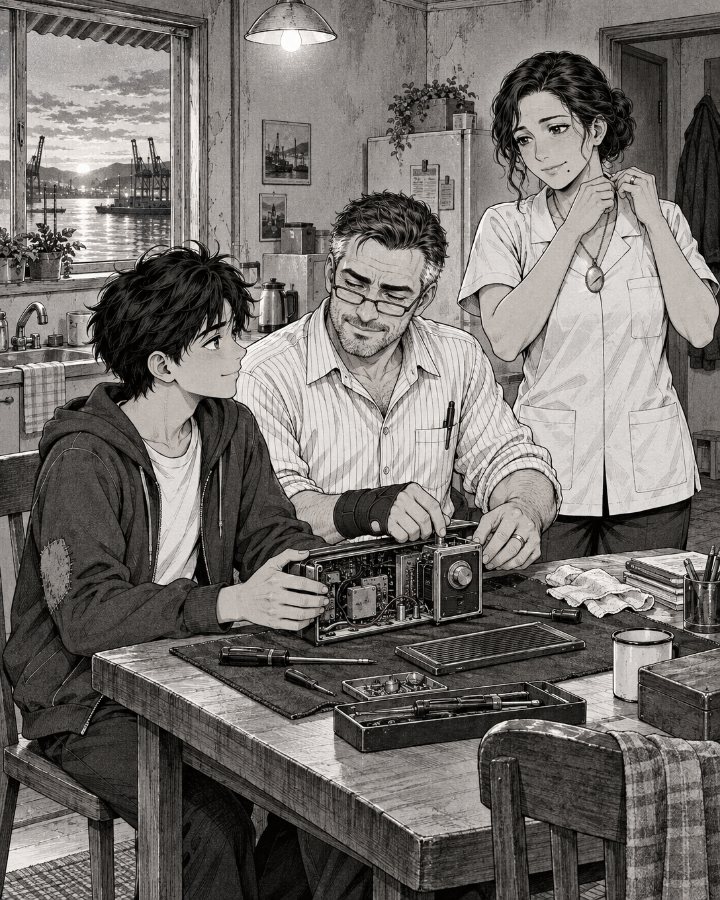
At home, Noah steadies an opened battery radio while Daniel tests the repair with a small movement of his braced right hand. Mira stands nearby fastening her necklace. Noah notices the bent clasp and offers to fix it after the radio; she says tomorrow will do. The radio crackles alive, earning a small shared smile from father and son.

Noah Vale: That clasp's bent, Mum. I'll fix it after the radio.

Mira Vale: Tomorrow will do. Let's hear this first.

KRR—SHH
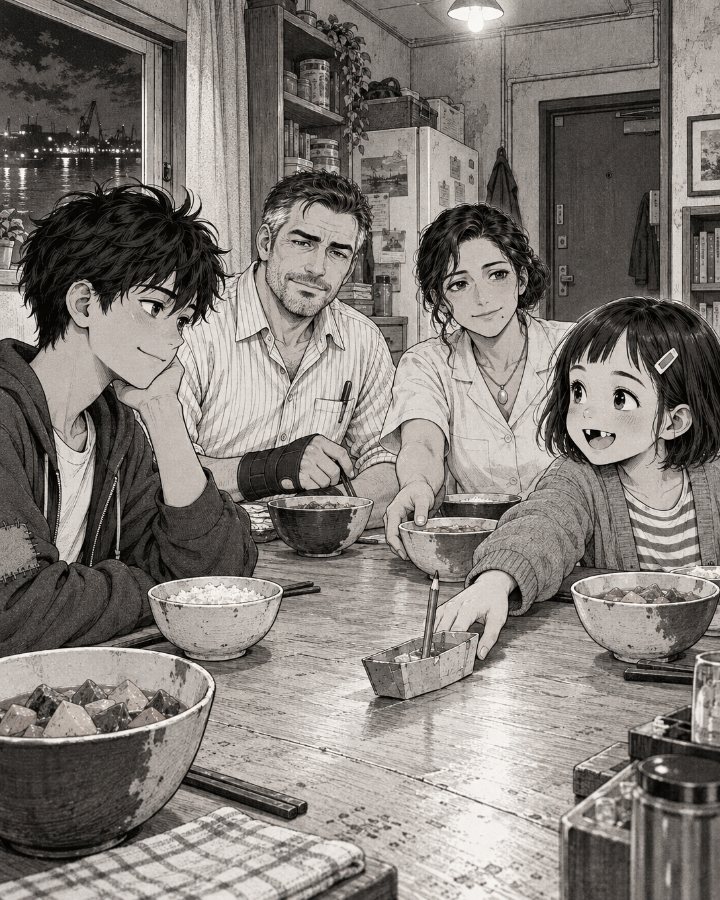
The repair tools have been cleared away for dinner. June pilots her cardboard boat between the bowls and asks whether Noah's future boat will have room for the whole family. His answer is teasing and familiar, a genuine moment of ease rather than proof that the day no longer hurts.

June Vale: Will your boat have room for all of us?

Noah Vale: Depends. Are you bringing all your cargo?
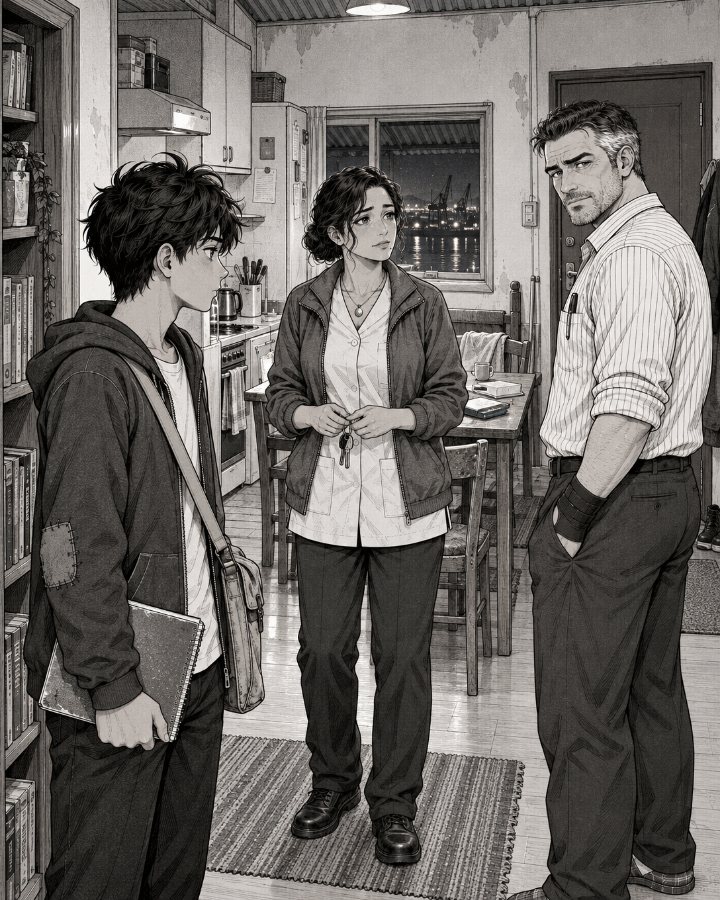
Near the entrance, Noah overhears his parents quietly comparing the rent and heating shortfall. Daniel proposes asking for an extension. When he notices Noah listening, he turns toward him without blame and makes the boundary clear: the adults will handle the calls. Mira has her jacket and work keys ready; she leaves for her night shift after this exchange.

Mira Vale: Rent leaves us short on heating.

Daniel Vale: I'll call for an extension.

Daniel Vale: Finish your homework. We will handle the calls.
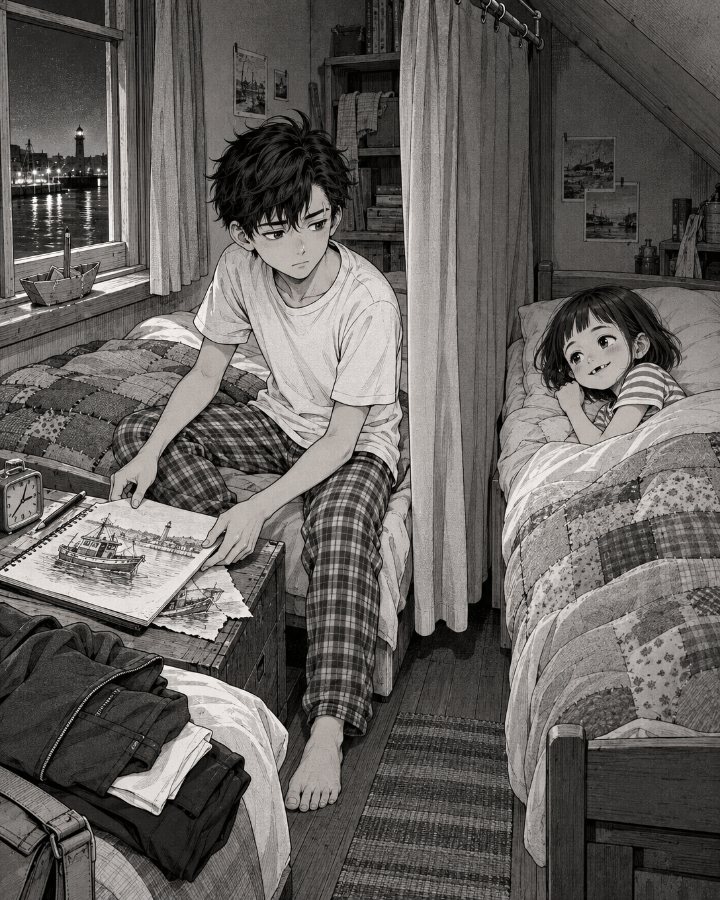
June notices the harbor outline around Noah's boat. His embarrassed answer earns a sleepy, amused look. As she settles, he slides the torn loose study beneath the intact sketchbook on the crate, leaving a jagged edge visible. His gaze shifts to the folded school clothes at the foot of his bed. The invitation by the water still matters, but so does Mason's threat. Ordinary exhaustion eventually carries him into sleep.

June Vale: Who drew the harbor?

Noah Vale: A girl from school.

Noah Vale: What if he's waiting tomorrow?
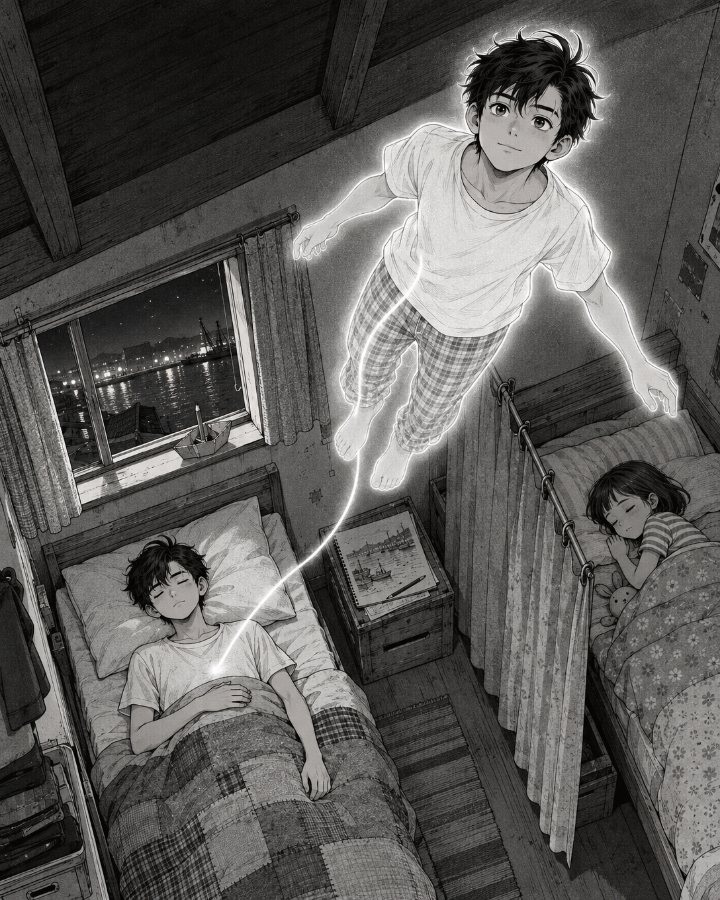
The same bedroom is suddenly seen from far above. Noah's physical body sleeps safely in the left bed while his identical barefoot astral self floats above it. A fine white tether connects them. June sleeps undisturbed behind the half-drawn curtain. Believing this impossible space to be a vivid dream, Noah allows himself a small, relieved smile.

Noah Vale: Finally. A little room.

Episode 2: What a Dream Shouldn't Know

The recovered locket proves that Noah's journey was real. His family also learns the severity of the bullying and commits to supporting him. The existing ten-frame story remains unchanged.
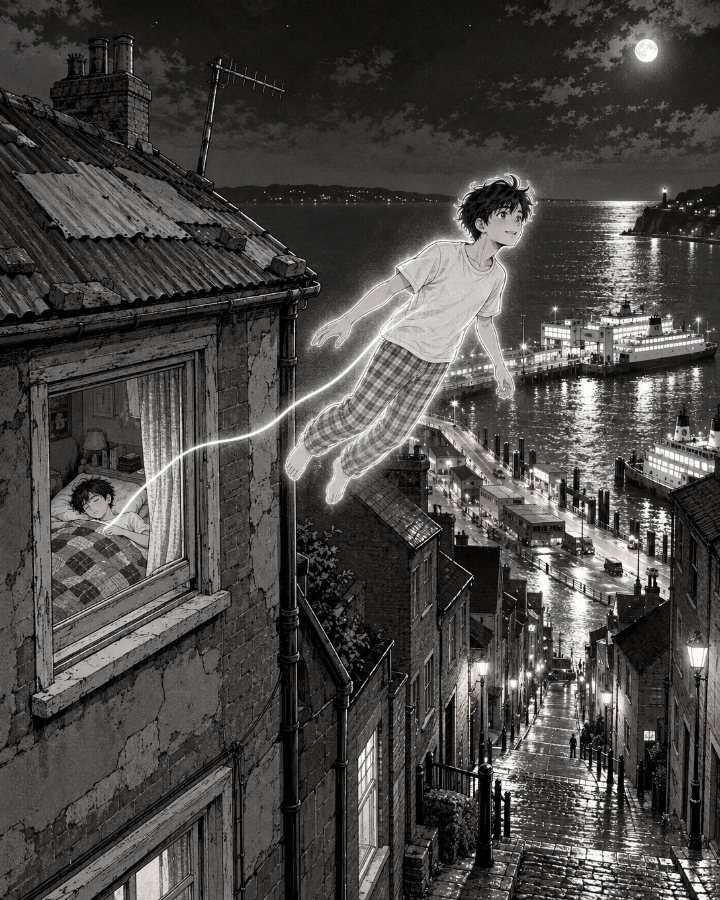
Continuing the same night, Noah's astral self drifts harmlessly through the bedroom wall and out above Hill Street. His bare feet are just clearing the intact plaster. Through the nearby window, his physical body remains safely asleep in the left-wall bed; June is concealed behind the privacy curtain. A fine white tether connects Noah to his sleeper. The steep street descends toward the illuminated ferry terminal, drawing his delighted attention.

Noah Vale: At least dreams don't charge fares.
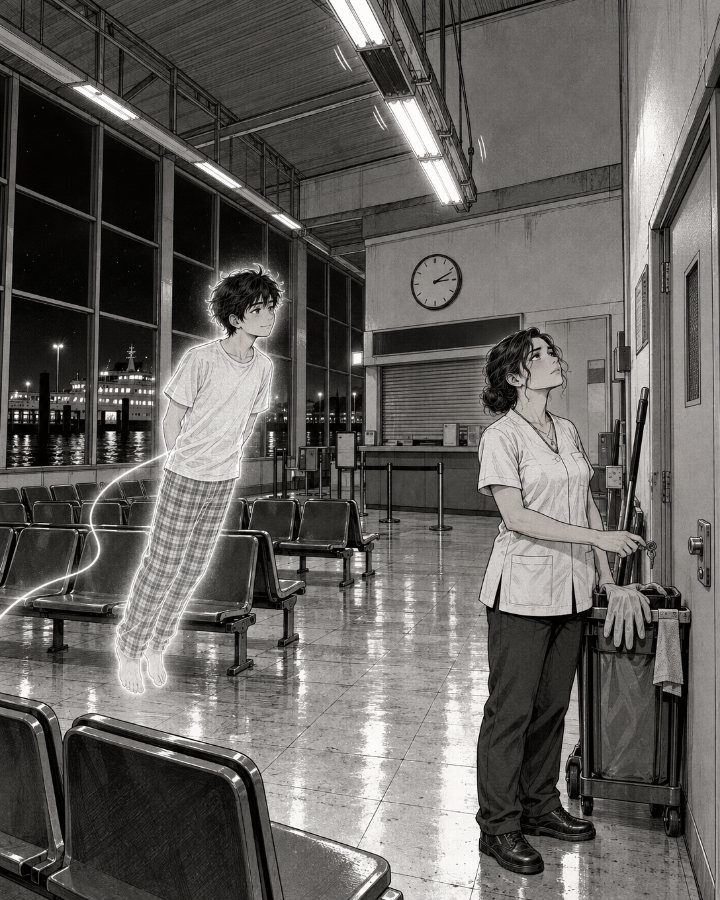
Inside the empty concourse, invisible Noah watches Mira beside her cleaning trolley and the closed staff door. Her dented oval locket still hangs at her neck. One bank of fluorescent lights flickers twice. Mira pauses with her work key ready and looks up, tired rather than alarmed, before unlocking the door. Noah dismisses the familiar workplace as scenery borrowed by his dreaming mind. His tether trails back out of the terminal toward home.

Noah Vale: Mum's work. My brain's borrowing the scenery.

FZZT. FZZT.
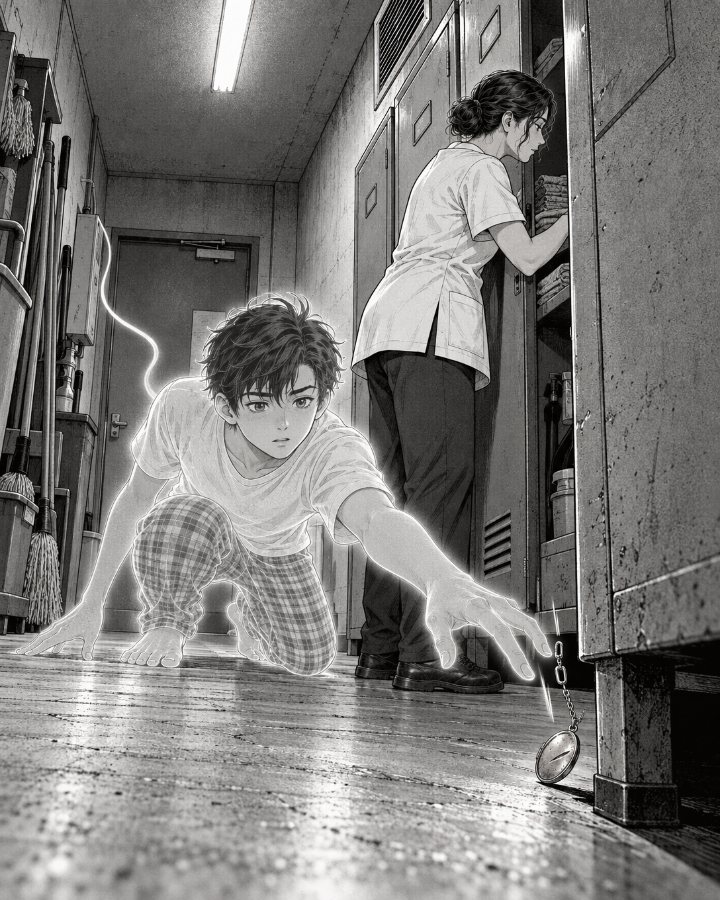
Mira has entered the staff corridor and closed and locked the door behind her; Noah has followed through it without moving it. Three lockers line the right wall, the third beneath a ventilation grille. As Mira reaches into the slightly open third locker for supplies, her chain catches on its projecting catch and the bent clasp breaks unnoticed. The locket and chain slip into the gap behind the locker's back-left foot. Noah drops after them, but his translucent fingers pass through both the metal necklace and the locker base. Mira's neck is now bare.
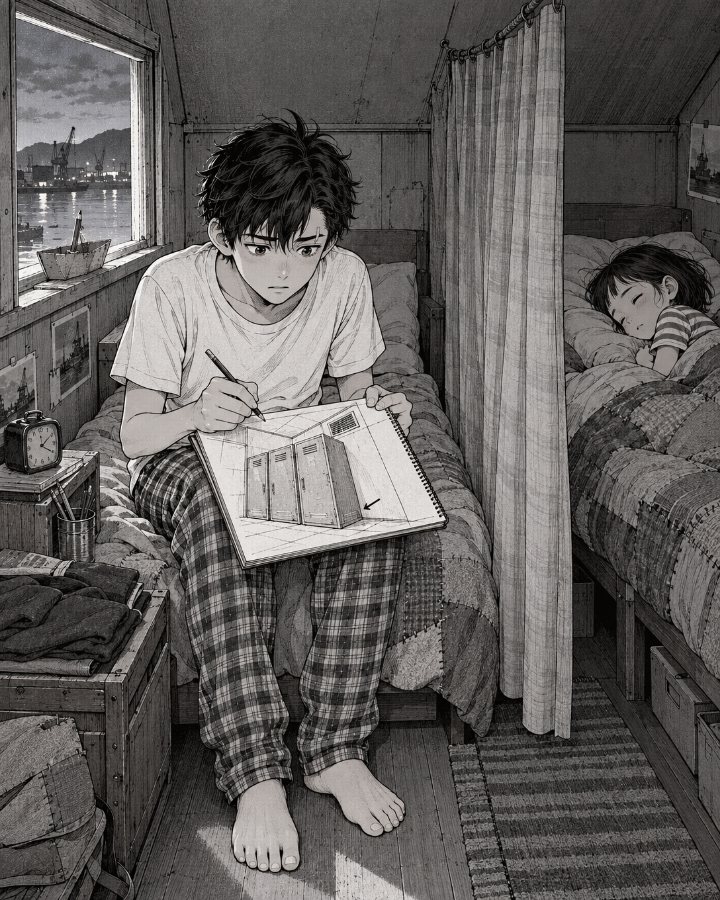
Noah wakes abruptly before Mira returns and reaches for his sketchbook immediately. Still in his sleepwear, he sits on the edge of the left-wall bed and records three lockers, the grille above the third, and an unlettered directional mark locating the gap behind its back-left foot. His pencil moves urgently, but his expression is unsettled: he has never visited this room. June sleeps undisturbed behind the half-drawn curtain.

Noah Vale: I've never been in that room. How do I remember it?
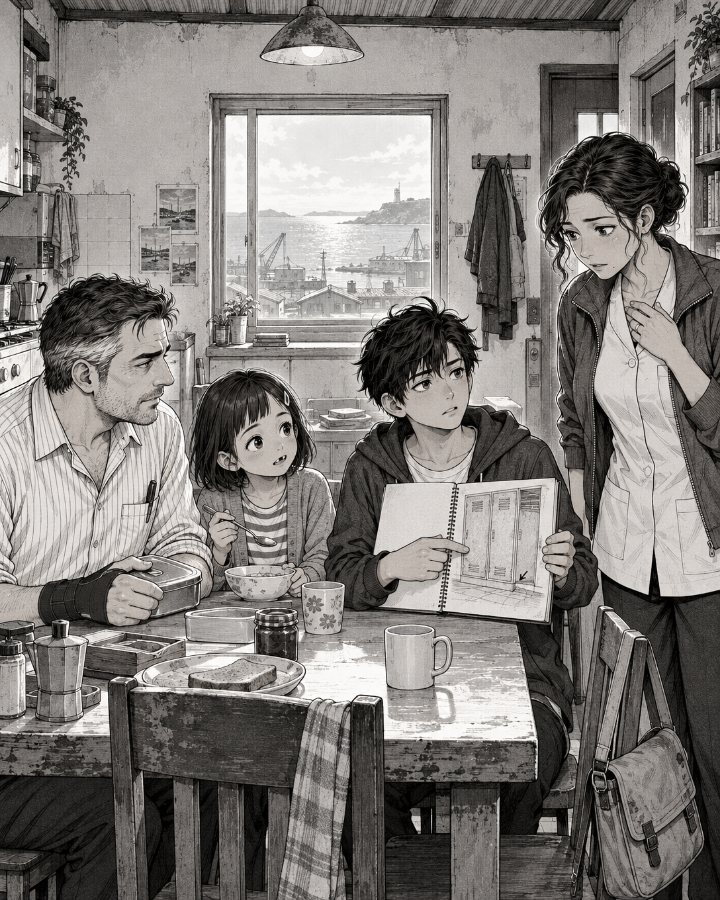
At breakfast, Mira has just returned from work with her jacket open and her neck visibly bare. She mentions the missing locket, assuming it fell off on the bus. Noah opens the corridor sketch he made before her arrival and gives the exact location. Daniel stops packing a lunch container, his braced right wrist supported on the table. June pauses over her bowl. The already-drawn page sits between the startled parents as evidence that Noah is not simply guessing after hearing about the loss.

Mira Vale: My locket's gone. Maybe on the bus.

Noah Vale: I think it's under the third locker at work.

Daniel Vale: How do you know that room?
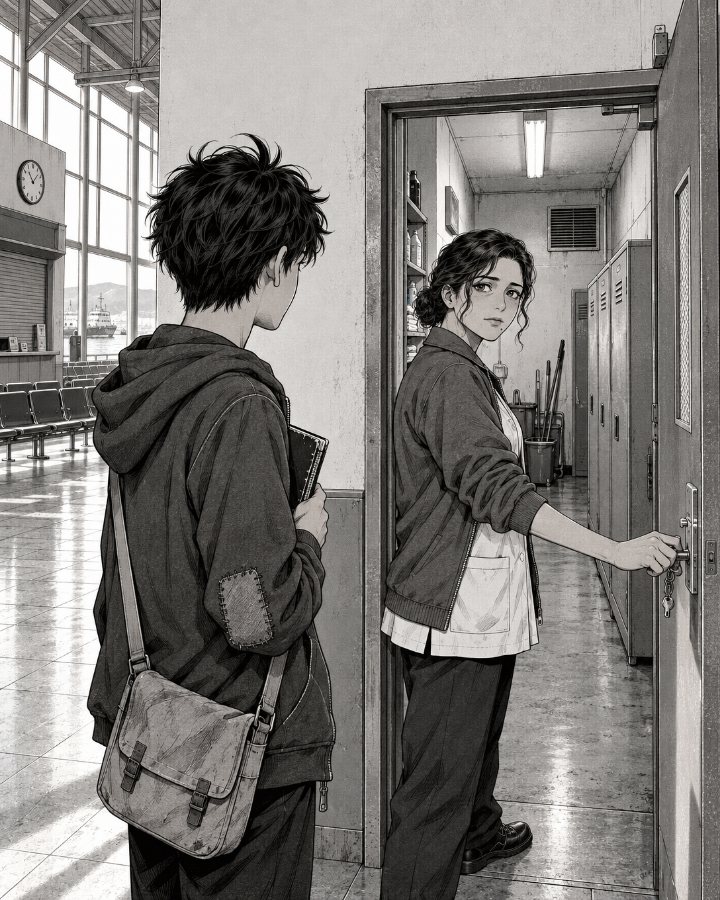
Mira agrees to check before school and accompanies Noah back to the terminal. At the rear staff door, he waits beside her while she unlocks it. She gives him permission to enter and quietly confirms that he has never been inside. Through the opening, the three lockers and the grille appear exactly as he drew them. His expression shifts from doubtful expectation to frightened recognition. Mira's neck remains bare.

Mira Vale: You can come in. You've never been here, have you?

Noah Vale: No. But that's the grille.
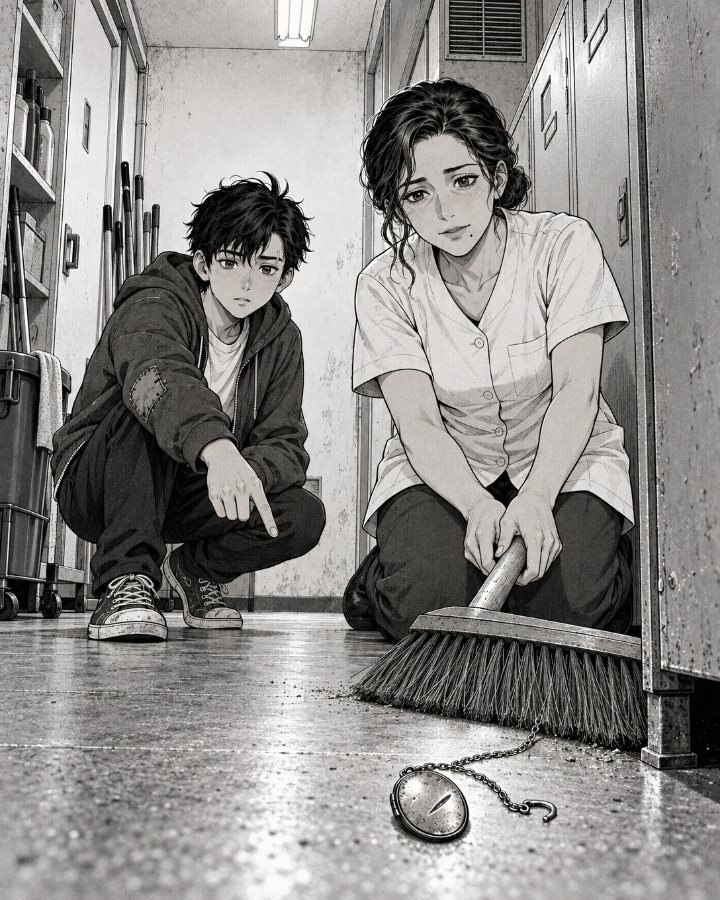
Noah crouches and indicates the gap behind the back-left foot of the third locker beneath the ventilation grille. Mira kneels and carefully draws the broom toward the aisle. The bristles pull out the thin chain, followed by the familiar oval locket with its diagonal dent and the broken bent clasp. The necklace's emergence into the hard light is the central visual proof. Noah does not retrieve it himself; Mira performs the physical recovery.

Noah Vale: There. Behind its back-left foot.
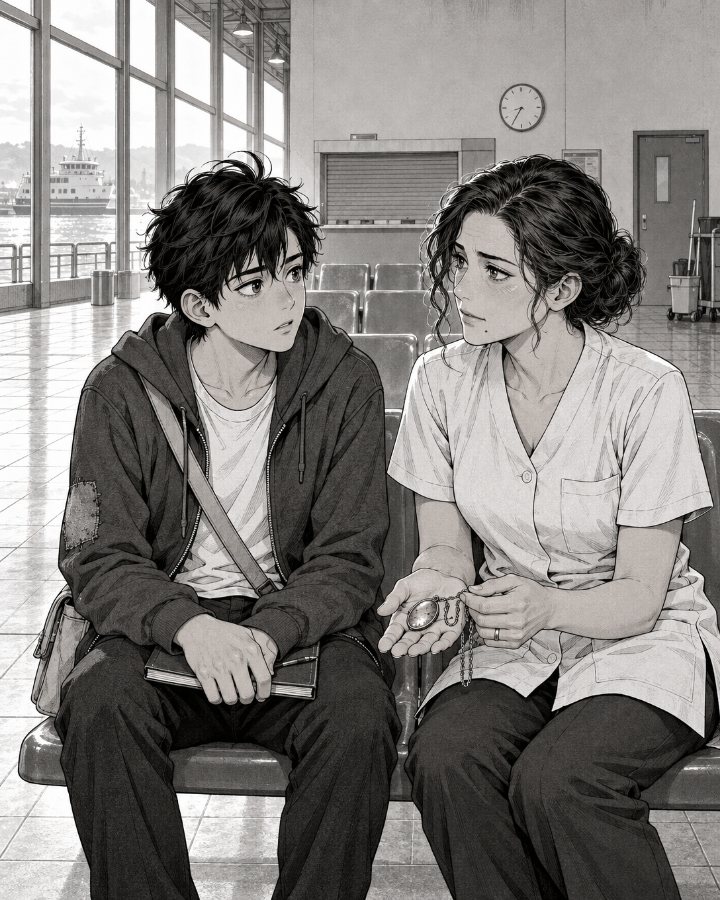
Mother and son sit together in the quiet concourse. Mira holds the recovered locket and broken chain in her bare palm rather than trying to wear them. Noah mentions the two flickers and her upward glance. She confirms both the detail and that she was alone behind the locked door. With the necklace resting between them, Noah finally accepts that he witnessed something real. Mira stays attentive to him despite her own astonishment.

Noah Vale: The lights flickered twice. You looked up.

Mira Vale: Twice. I was alone. I'd locked that door.

Noah Vale: Then I wasn't dreaming.
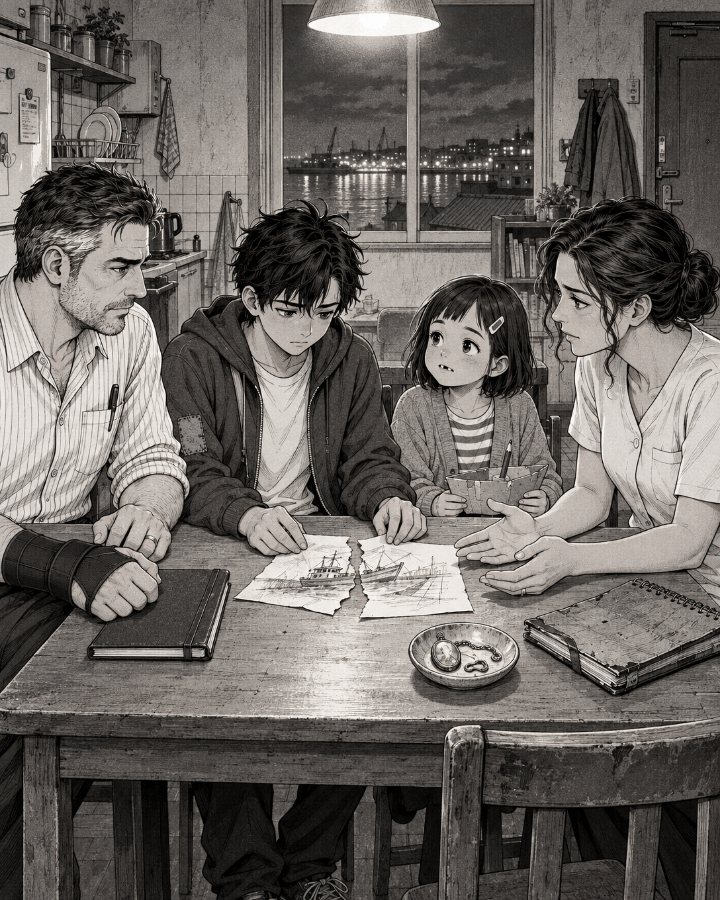
That evening, after explaining the journey, Noah has finally told his family the full severity of Mason's bullying: repeated class-based humiliation, blocking his way, grabbing his belongings, dumping the satchel, tearing the loose boat study, and shoving him hip-first against the desk. He repeats Mason's quiet warning, 'Tell a teacher and tomorrow's worse,' and admits that even after the teacher recorded the incident and kept Mason away for the rest of Day 1, he has been dreading corridors and changes of lesson. No new assault is shown. The torn study lies plainly beside the household notebook; Noah keeps its two largest pieces carefully aligned, his shoulders still drawn in. His parents believe him without minimizing the shove or treating the threat as a joke. Daniel separates adult financial responsibilities from Noah's burdens. Mira will provide a written account of the shove and retaliation threat, preserve the torn drawing as evidence, and request a school safety meeting. They identify Ms. Bell, the off-page teacher who recorded the first report, as the named trusted adult they will ask the school to confirm for Noah's check-ins. They will request staff-supervised transitions and separation from Mason to reduce retaliation, with follow-up rather than a promise that reporting instantly ends the danger. June's gentle question creates a small breathing space. The ability is neither a financial solution nor a means of revenge.

Daniel Vale: Our bills are ours. None of this is your fault.

Mira Vale: I'll meet the school with you. We'll make a plan to keep you safe.

June Vale: Can you see the tops of clouds?
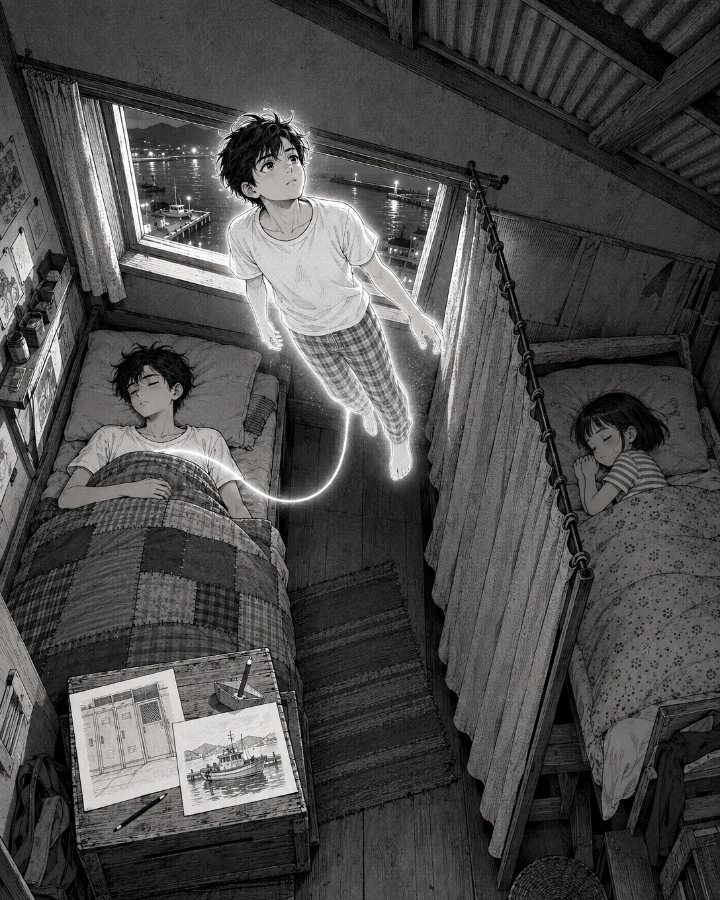
Echo Episode 1's final overhead bedroom composition. Noah's physical body sleeps safely in the left-wall bed while his identical astral self rises diagonally toward the window, connected by the fine white tether. June remains asleep behind the half-drawn curtain on the right. On the bedside crate, the corridor sketch lies beside the intact boat drawing with Lena's harbor outline, preserving both the mystery and the tentative connection in his waking life. The torn study has been left with his parents for documentation. Noah is still uncertain, but he no longer feels entirely alone with either discovery or fear.

Noah Vale: Tomorrow still has the same problems. But the world is bigger than I thought.

More stories

  • Dune Runners by Neon Harbor (Action · Futuristic · All ages): A teenage junkyard mechanic races her rebuilt hover-bike against a champion team that will do anything to win.
  • Detective Pati by Kervan Studio (Kids · Cartoon · All ages): A street-cat detective follows the trail of Uncle Hasan's missing simit cart.
  • Why Is the Sky Blue? by Little Lantern (Learning · 3D animation · All ages): A curious girl and her pocket-sized robot ride a sunbeam to find out why the sky is blue and sunsets are red.
  • Captain Barnacle's Lost Tooth by Neon Harbor (Kids · Pixel art · All ages): A clumsy pirate captain loses his famous gold tooth, and his crew chase it across the islands to a grumpy giant crab.
  • The House on Fog Hill by Inkwell Tales (Mystery · Manga · 13+): Three friends dare each other into a fog-wrapped house and meet a lonely ghost with one last letter to deliver.
  • The Moon Who Couldn't Sleep by Little Lantern (Kids · Storybook · All ages): A little girl and a wise old owl sing the tired Moon to sleep.
  • The Last Penalty by Paper Comet (Drama · Realistic · All ages): A small-town girls' football team is in the regional final, and it all comes down to the reserve goalkeeper and the last penalty.
  • Postcards from Mars by Little Lantern (Kids · Storybook · All ages): A boy in the first Mars colony draws postcards for his grandmother on Earth, and the last postcard brings a surprise.
  • Two Umbrellas by Paper Comet (Romance · Anime · All ages): Two strangers keep swapping identical yellow umbrellas at a rainy ferry stop, and start writing to each other.
  • The Last Caravan by Kervan Studio (Fantasy · Artistic · All ages): A young camel driver and an old storyteller carry the last seed of a lost tree across the desert where the stars walk, to a dying city.